A barber already knows what a walk-in is worth. What he's never had is a way to know the man is actually coming — and a way for the man to know he'll be taken. That's the whole product, and it's what you're in the shop to show him.
Start here →What you're selling
A potential walk-in who says he's on his way is a gamble for both sides. An appointment is a commitment, but a rigid one. What we're offering is a commitment without the clock.
The customer isn't holding a number — he's holding a claim, and it binds both ways. He knows you'll take him; you know he's coming.
NextUp makes a walk-in as reliable as an appointment without tying anyone to a time — customers claim a spot by QR code, Google, Yelp, Instagram, WhatsApp or a call, and watch the line move.
"It's booking, minus the appointment. He claims a spot from his phone, sees he's fourth with about 25 minutes, and you know he's actually coming."
"You get the reliability of a book without running one."
Appointments solved certainty for people who plan. Nobody solved it for the man who just walks in.
And the difference between a claimed walk-in and an anonymous one isn't a feeling. It's measurable, and it's roughly double.
Why it's worth money to him
39%
of anonymous walk-ins come back.
78%
of identified first-time bookings come back.
Source: Boulevard. Shop and salon new-guest visits fell ~17% in 2025 (Zenoti, State of the Industry).
That gap is the entire business case, and it's why the claim matters more than the queue. A man who joined the line left you a name and a number. A man who stood in your lobby left you nothing — and he's half as likely to ever come back.
He isn't buying a queue. He's buying the difference between 39 and 78.
This already works
Great Clips launched Online Check-In in 2011. Supercuts added one in 2012, Sport Clips in 2018. Your customer already knows how to do this — a chain taught him.
The Great Clips check-in app, across 4,400+ salons.
People don't rate software they hate.
Great Clips' own brand marketing director — back in 2014.
"While the app doesn't technically book an appointment time, it puts your name up on the virtual board so that when you walk in the door, you're ahead of anyone who walked in or used the app after you."
Regis, which owns Supercuts, tells the SEC in an audited filing that serving walk-ins and minimising guest wait times are "essential elements in delivering an efficient guest experience." And there's peer-reviewed work behind it: a 2013 Management Science study found customers react to the line they can see, not the wait they'd actually have — a longer visible queue cut purchases by about 10%, and only 7% of those sales were recovered anywhere else. (Supermarket study, not a salon — say so.)
You're not asking him to try something new. You're asking why the chain down the street has it and he doesn't.
The field
We inspected 102 independent barbershops across Manhattan, Brooklyn and Queens. One had a walk-in queue. Not one in ten — one in a hundred.
And the reason isn't that barbers looked at it and passed. Google and Yelp give a barbershop no way to publish a wait time at all. Google has a join-the-line rail and ships it to restaurants only; the list of actions a shop like his may attach to its listing is a fixed set — book an appointment, order food, shop online — and a waitlist isn't on it. Yelp's waitlist asks "do you work at or own a restaurant?" and charges $129–349 a month.
"Google built a join-the-line button and gave it to restaurants. Yelp sells one to restaurants. Neither of them ever built it for barbershops — the only thing you're allowed to put on your listing is a booking link. The chains got around it by building their own apps. You never had anything to stand on."
There is one door, and it's the one we use: a shop may publish its own booking link with no permission from anyone. So his listing gets a "Book online" button, and the tap lands on his queue.
His QR, his window, his listing link. That is the whole distribution surface — so put them everywhere.
Who to walk into
A paper list, a legal pad, a dry-erase board with first names on it. It's the strongest buy signal there is, because you're replacing an object he can point at. Also good: people waiting on a bench, a handwritten "walk-ins welcome", a phone ringing that nobody picks up, and no booking-platform sticker on the glass.
"By appointment only." Wrong product — he already solved certainty, rigidly.
One chair. One barber doesn't need a queue. He needs a calendar.
A receptionist at a desk. The queue is her job. That's a different, harder sale.
Busy is good. Visibly badly organised is better.
Once you've picked the shop, the goal of the first contact isn't to sell. It's to get enough to build his shop before you ever walk in.
The demo
A man filling in a web form isn't surprising in 2026 — he's done it at the DMV. The moment that lands is his own name arriving in his barber's hand, with nobody having told the barber.
Never yours, never a fake name. He has to be the one in the line.
Not the owner — the employee. He needs to watch someone untrained get it right first try. That's the staff-adoption objection dying before he raises it.
Step back for ten seconds. If you're tapping, you're demoing software. If they're tapping, they're running their shop.
That's the whole training. Then hand the owner the tablet so he sees every chair at once.
Demo one channel perfectly. Mention the rest.
How a shop goes live
Onboarding is white-glove and done by hand, on purpose — every early shop teaches us what the self-serve version eventually has to do. You are not setting up software in front of him. Most of it is built beforehand from what is already public: his listing has the name, address and hours; his Instagram has the artwork.
In the shop it is a short visit — correct what we guessed wrong, put the station at the chair, place the sign where people actually stand, and connect the listings he already owns so they become a front door.
Then you come back. The only number that matters in the first fortnight is whether anyone was actually served. Nothing after a few days is almost always sign placement, not product.
Configured is not installed. Used is installed.
What else comes with it
Lead with the line, always. Bring these up when he asks "what else does it do?" — never as the opening. Everything here is live today and safe to show.
His own page at a clean link, working from Google, Yelp or his Instagram bio. Appointments and the walk-in line run side by side — he doesn't have to choose.
A live storefront screen: the wait, a QR, his hours, his photos. Any screen he already owns.
Everyone who joins leaves a name and a number. That's the 39%-to-78% difference, and it accumulates whether or not he ever looks at it.
Barbers run the line from their own phones by text — NEXT, SKIP, QUEUE — with no app to install.
On the App Store and Google Play. The shop in his pocket.
Send a review link to a customer who just got served, tracked.
Before you promise anything
This section exists because the alternative is you finding out in a shop, in front of your own contact. Your standing in your community is the one asset here that can't be rebuilt with a software fix, so we'd rather you walked in knowing.
What you can show, on any shop, today: a printed QR to a live queue, the same link working from a Google or Yelp listing, the customer watching their place, and the barber advancing the line with one tap. That's enough. It's the part he'll actually use on Saturday.
Sell the part that works. It's the part that sells.
The price
Flat, per shop, unlimited barbers. A free printed sign. A $99 one-time setup that covers the sign and the visit where you install it.
Every barber, every surface. 800 texts a month and the printed sign included. This is the plan you sell.
Everything above plus the AI answering the phone, and 1,600 texts. Sold to shops already losing calls.
$50 on the queue plan, $100 with the AI line. Covers the sign and the visit. Its real job is commitment: a shop that won't pay it won't do the work either.
Locked 12 months for the first shops. Say it as a discount with an end date — never as the price.
Carriers deliver the messages, not us — delivery isn't guaranteed, and if carrier fees move, pricing can change with notice.
Individual barbers are free inside a paid shop account. A chair renter managing his own clients doesn't have a queue problem — he has a calendar problem, and that fight is already being given away for nothing. Don't sell into it.
One haircut a month, against four he'd have lost. Let him do that arithmetic himself.
He will tell you someone else does this cheaper. Here is what those people actually charge, and what they actually do.
What he pays elsewhere
| Who | What a 4-barber shop pays | What they actually do |
|---|---|---|
| NextUpService | $99–140 $249 with AI phone |
A barbershop walk-in queue. The same job, same buyer — and their floor is double ours. |
| Booksy | $89.99 $29.99 + $20/extra barber |
Booking. Priced per seat, so it gets more expensive every time he hires. |
| Squire | $50 Pro +$99 for AI · $150 Executive |
Booking, with a waitlist feature inside it. See below — this is the objection you'll hear. |
| Waitly · TablesReady | $49–99 | Generic waitlists, priced by message or party volume. Not built for a shop. |
| Yelp Guest Manager | $159–349 | Restaurants. Useful only as the ceiling for what a queue is worth to a business. |
Published pricing, checked 12 September 2026. Quote the range, not a precise figure — these change.
"Theirs is a waitlist inside a booking app — you add people to it. Ours is a line your customer joins from outside the shop, from your Google listing or a code in the window, and watches move on his phone. He never has to be standing in your lobby to be in your line."
"That's a cancellation list — it tells people when someone else drops out. It's not a line anybody's standing in. Their whole New York barbershop directory doesn't use the word walk-in once."
That difference is the whole product, and it's why the comparison that matters isn't Squire — it's NextUpService at $99, who sell the same thing to the same barber and have decided that's what it's worth.
The category charges $49 to $140 for this. We're at the bottom of it, on purpose, for now.
What you earn
Tracked by your own code, so a shop is yours the moment it signs up with it. You're paid on gross profit — revenue minus what the shop actually costs to run — which means you earn more when a shop is on a real plan than when it's on the cheapest one.
| A shop on $49.99 | Typical month | Heavy use |
|---|---|---|
| Revenue | $49.99 | $49.99 |
| Costs — texts, processing, the sign | $19.50 | $25.75 |
| Gross profit | $30.49 | $24.24 |
| Your half, every month | $15.24 | $12.12 |
You bear: promotion, your own people, training the shop, first-line questions.
We bear: the signs and the money to make them, all engineering, billing, and anything
that needs a developer.
Fifty shops is about $760 a month, recurring — and it keeps paying while they stay.
The numbers
Assumes an even split between the $49.99 and $99.99 plans, after the cost of texts, the number and card fees.
| Shops | Monthly revenue | Gross profit | Your half |
|---|---|---|---|
| 25 | $1,875 | $1,083 | $542 |
| 100 | $7,500 | $4,332 | $2,166 |
| 350 | $26,250 | $15,162 | $7,581 |
| 1,000 | $75,000 | $43,320 | $21,660 |
What each of those actually takes. One person installing 3 shops a day, every working day, lands near 350 by the end of February. A thousand needs roughly 9 a day — three or four people installing, not one. That's the real difference between the two bottom rows, and it is a staffing decision rather than a selling one.
The ceiling isn't how many shops want it. It's how many hands can turn one on.
The economics · current direction, not a fixed plan
Most software companies have a single economic engine: a subscription that slowly repays what it cost to win the customer. Walking into shops is expensive, and waiting a year to break even on each one is how a field team runs out of money before it finds its rhythm.
So we are trying to build this with two. The intent is that everything arriving in the first month — the setup fee, the first month of subscription, and the sign if he buys one — covers what it cost to work that block of shops. The recurring subscription is then clear, and it is what funds the company rather than paying back the visit.
The rep is paid per visit whether or not the owner is there, so a block of 100 shops costs roughly the same regardless of outcome. Divide that by how many sign: at a 10% sign-up rate it is about $360 a shop; at 20%, about $180.
Monthly recurring revenue is the subscription, every month, for as long as he stays. It is the only line that compounds — each new shop adds to it without the previous ones costing anything more.
Setup fees plus the first month plus any sign margin. When those three together cover the field cost, the block of shops has paid for itself and the MRR underneath it is clear.
Why the sign matters more than it looks. It is not an accessory. It is what makes the queue visible from the pavement, and its margin is what closes the gap between the setup fees and the cost of the visit. A cohort that buys signs funds itself in month one; one that does not takes a few months longer.
The first month should pay for the walking. The subscription pays for everything else.
What's coming
Show these to explain where the product is going — never to close. What a shop can put in a window today is the printed sign with a live QR. Everything below is design, not stock.
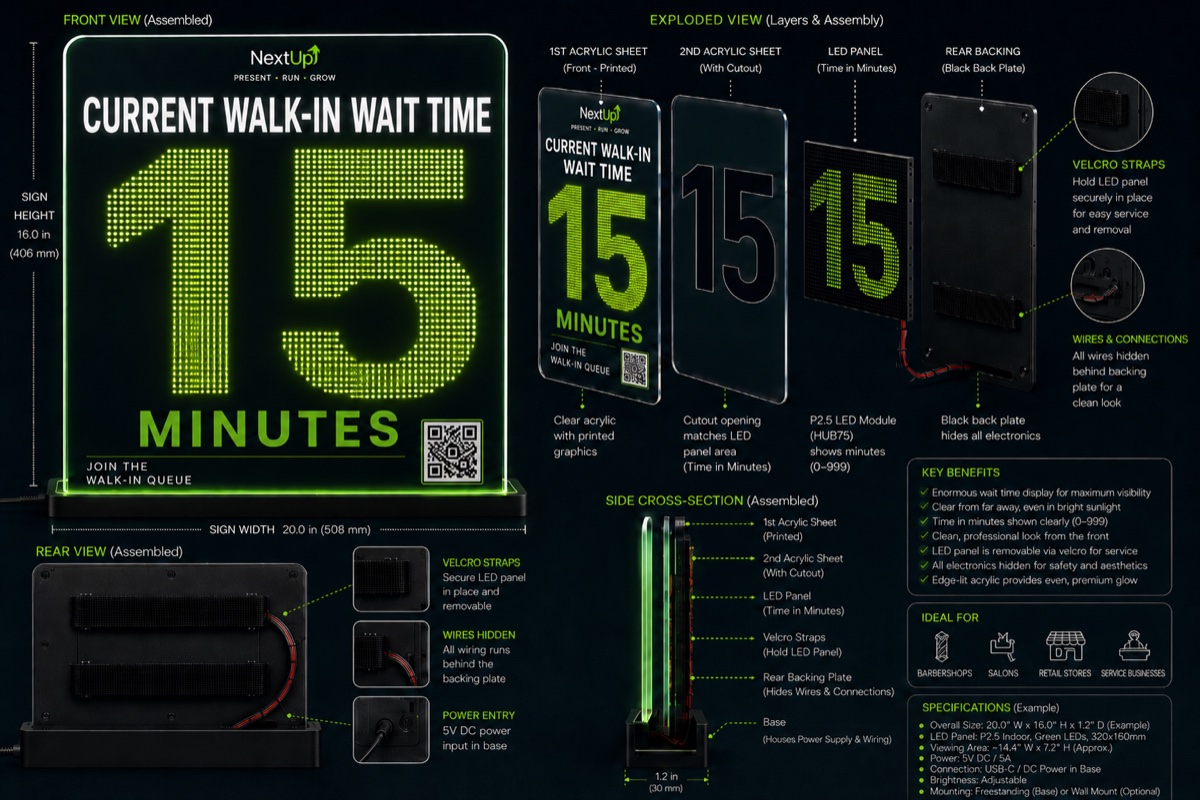
Edge-lit acrylic over a P2.5 LED panel — the same interface as the window sign already running in a shop. 20″ × 16″ × 1.2″, 5V, velcro-mounted panel so it can be serviced. Shows the live wait and nothing else.
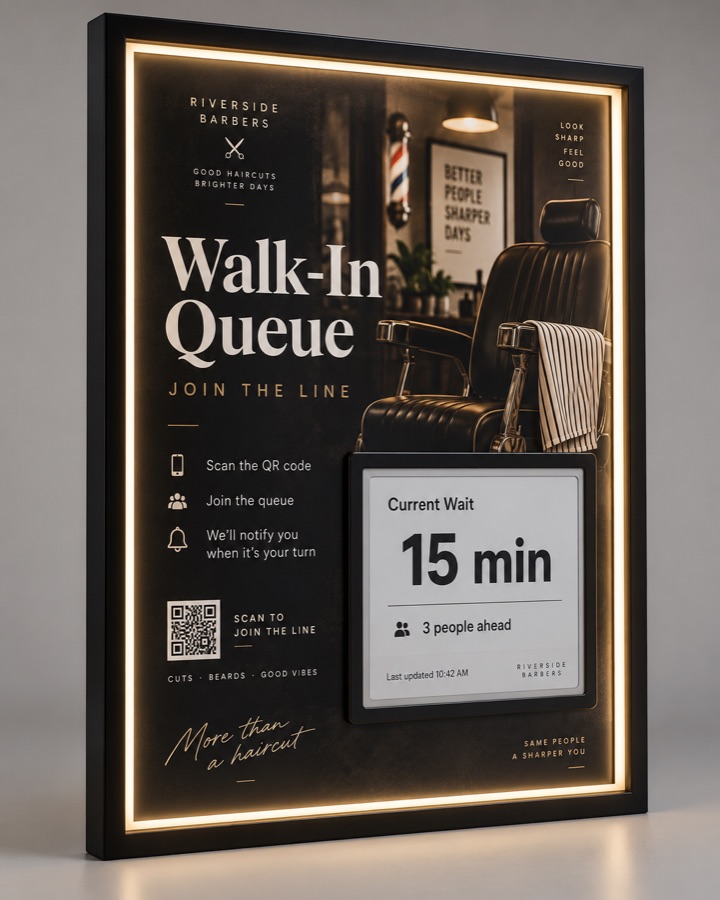
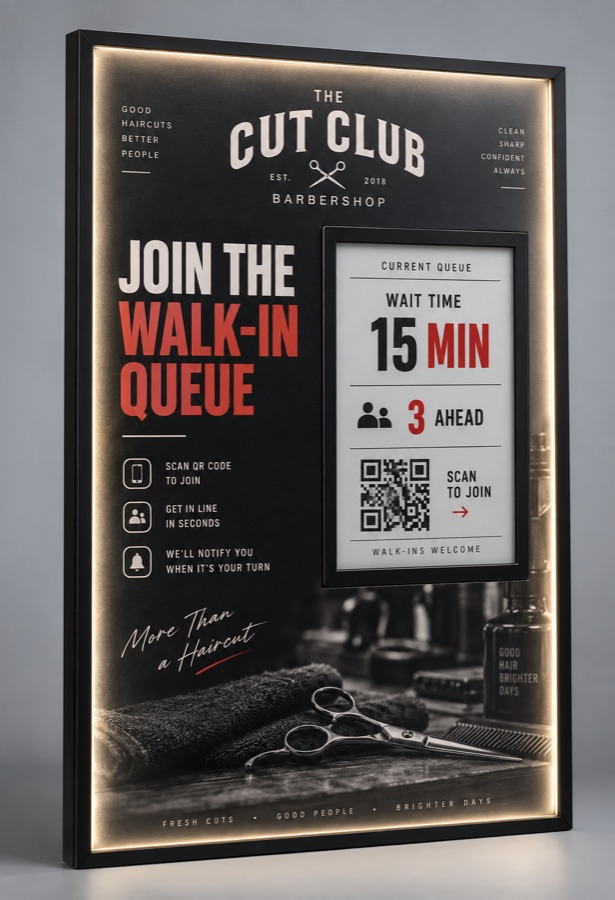
The shop's own artwork, with a small e-paper display carrying the live wait. The QR stays printed — so if the panel ever dies, people can still join the line.
Same idea, louder. Artwork is generated per shop from their own ads and Instagram, so the sign looks like it was made for them — because it was.
The sign isn't decoration. It's the claim, displayed to someone still on the sidewalk.
Also coming · not built yet
Everything so far is the shop's side of the product. The other half is the person waiting in the chair — and an app they'd actually keep. Same rule as the section above: this is design, not stock. Nobody can download it today, so don't let a shop believe otherwise.
Step out for a coffee and hold your spot in line. A paper list can't do that. Neither can a text message.
Join a line or book a chair without retyping your name, number and email at every new shop.
Your live position, pushed to your phone. Every text a shop doesn't have to send is money off their bill.
The pitch to a customer is one sentence — "download it once, and never fill out another booking form at a NextUp shop" — and it gets stronger with every shop you sign, because the app someone installed for your barber already works at the next one.
The shop is the customer. The customer is the network.
After he says yes
Not scans, not signups, not page views. Someone tapping Done is the only event that proves the shop is running on it.
| Served in 7 days | What it means | What you do |
|---|---|---|
| 0, and no joins | The sign is invisible. Placement, not product. | Go move it, in person. |
| 0, but joins > 0 | Customers are in line and the barbers aren't tapping — people are watching a wait that never moves. | Stand at the chair. Today. |
| 1–5 | One barber gets it, the others don't. | Find out which, work the rest. |
| Tracks his chairs | He's running the shop on it. | Stop selling. Ask who's next. |
The second row is the dangerous one — it looks like success in every other metric, and it's the state where customers are being shown a promise nobody is keeping.
The second shop should come from the first. Every visit is a chance to ask who else needs this.
Get certified
This page is your training manual. The quiz draws 15 questions from the pool — the product, the pitch, the pricing and the field playbook. Score 12 of 15 to certify, then start booking demos. Unlimited retakes; every question explains its answer.
One rule that matters more than the score: setters book demos — they don't invent capabilities. If you don't know, say you'll find out. Nothing costs a partner his standing faster than a promise the product can't keep.
Take the certification quiz →